Turning enquiries into customers and filing them in folders
In Contact by Zaweba an enquiry becomes a customer with Convert to customer (Won), keeps its whole history, and can be filed in folders up to three deep.
Winning a customer is the moment an enquiry earns its keep. In Contact by Zaweba that moment is a single command, Convert to customer (Won), and nothing is lost along the way. The emails, contacts, notes, tags and stars that built up while you were chasing the sale all come with it. From there the customer can be filed into folders of your own design, so a long list stays easy to walk through.
From enquiry to customer
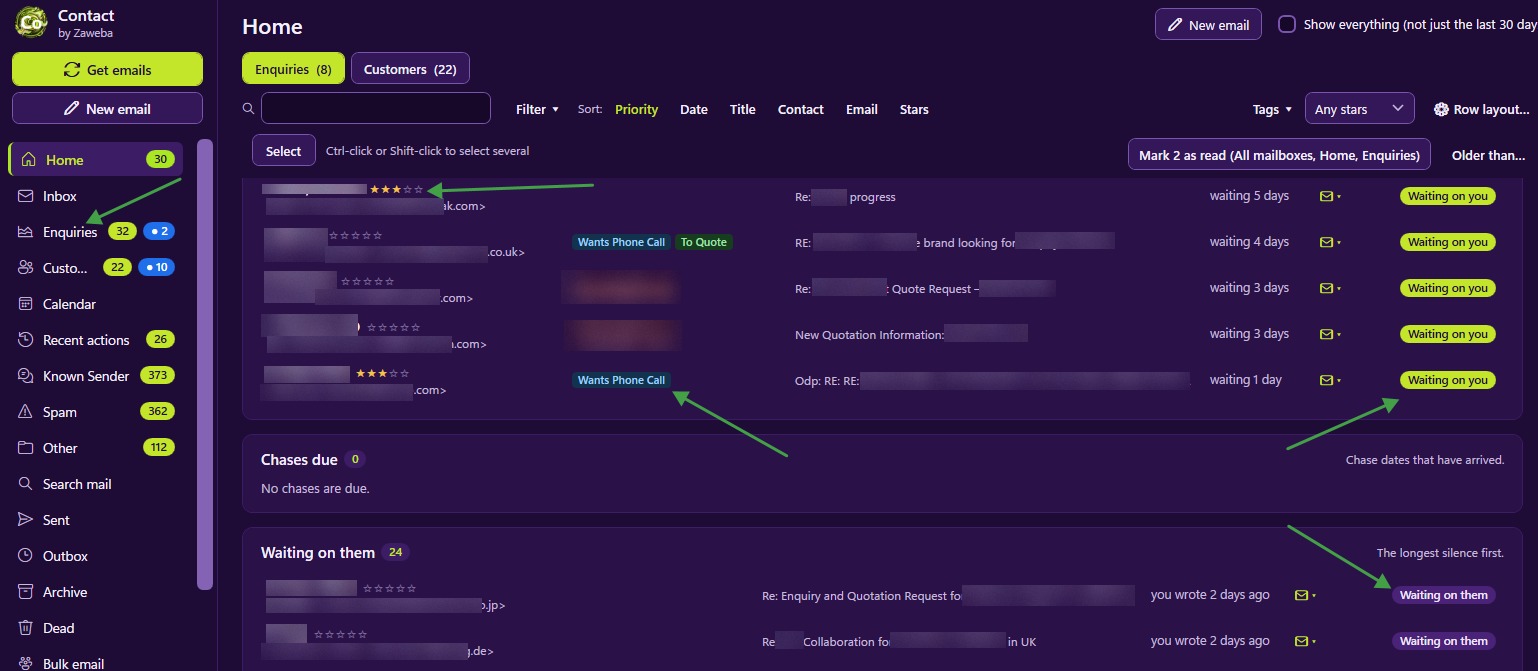
An enquiry is a record for someone who might buy from you. When they do, choose Convert to customer (Won) on the record. It moves from your Enquiries list to your Customers list and keeps everything. The conversation reads exactly as it did, so the next time they write about a delivery or a repeat order you can scroll back to the original quote without hunting through a separate system.
Mistakes happen, and the conversion is not a one-way door. Back to Enquiries reverses it, which is handy when someone said yes on the phone and then went quiet, or when you converted the wrong record in a hurry.
Some enquiries never turn into anything. Mark dead takes a reason, so later you can see why a lead went nowhere: they chose someone else, the budget disappeared, the job was too small. Bring back undoes it when a lost lead writes again months later. Keeping dead enquiries rather than deleting them means the history is there if the person comes back, and the reasons tell you something about the work you are quoting for.
Building a folder structure that works
Once you have more than a few dozen customers, a single flat list gets tiring. Customer folders let you group them up to three levels deep. A wholesaler might keep Trade and Retail at the top, with regions inside Trade. A web designer might use Monthly support, One-off projects and Former clients. A shop could split by marketplace, or by the brand the customer bought from.
Each folder shows counts of waiting and unread, so you can see at a glance which group needs attention today. If Trade shows three waiting and Retail none, you know where to start the morning. Moving a customer is a matter of dragging them between folders, so the structure can change as your business does.
Three levels is plenty for most small businesses, and resisting the urge to use all three everywhere is good advice. Folders that are too fine leave you with lots of near-empty groups and more clicking to find anyone. Start broad, and add a level only when a folder has grown big enough to be a nuisance.
Folders, tags and stars working together
Folders answer the question of where a customer belongs. Tags and stars answer different questions. A tag such as Refund or Return describes something going on right now, and it comes off when the matter is settled. Stars mark how much a customer matters to you, from none to five. A customer sits in one folder at a time but can carry several tags and a rating, and lists can be filtered by all three.
Used that way, you can ask for the five-star customers in Trade with an open Refund tag, which is a very short list of people you should ring today.
Habits that keep the customer list honest
Convert promptly. If a sale is agreed but the record still sits in Enquiries, its status keeps nagging you about chasing someone who has already bought, and your Home view fills with noise.
Use Mark dead rather than leaving an enquiry to rot. A dead record drops out of the chase lists but keeps its reason and its emails, and Bring back is always there.
Treat folders as a filing cabinet, not a to-do list. Who is waiting on whom is better left to the status Contact works out from the dates and to the counts on each folder. If you find yourself making a folder called Urgent, a tag or a chase date will probably do that job better.
Every one of these moves is listed in Recent actions with its own Undo, so trying out a folder structure carries little risk. Rearrange things, live with them for a week, and move them back if they don't suit.