Using Why is this here? to explain an email in Contact
Right-click any received email in Contact by Zaweba and choose Why is this here? to see what filed it, whether that still holds, and the fixes that fit.
Automatic filing is lovely until an email turns up in a place that makes no sense. A note from a supplier sits in a customer's conversation, or someone's personal email joins their employer's record. Most programs leave you to guess what happened. Contact by Zaweba has a command that tells you straight out: right-click the email and choose Why is this here?
What the explanation shows
Why is this here? works on any received email. It explains in plain words what brought the message into the conversation. Perhaps the sender is a contact on this record, perhaps their company domain matched, or perhaps a known contact's address appeared in the body of a web-form email. You get the actual reason, not a general description of how filing works.
It also tells you whether that reason still holds. Things change after an email arrives. You might have removed a contact since, or switched off domain matching. Knowing whether the rule is still in force tells you whether the next email from that sender will land in the same place.
The fixes on offer
Below the explanation are the fixes that fit this case. Depending on what brought the email in, you may be offered a few different ones.
Taking a contact off the record suits a sender who is listed as a contact but no longer belongs there, perhaps because they moved to another firm. Stopping domain matching suits a record that pulls in mail from everyone at a domain and is catching people who aren't part of the relationship. Keeping a sender out suits one person at a matched domain who should never be filed into this record, while everyone else still should. And moving the email, either to the Inbox to file it afresh or to another record where it really belongs, deals with the message itself.
Each fix is one entry in Recent actions with its own Undo. If you pick the wrong one, or change your mind after seeing the effect, undo it from there and the record goes back as it was.
Choosing between a one-off move and a rule change
The choice depends on whether the problem is this one email or the rule behind it. If the email is a one-off, a supplier copying in a customer say, moving it to the right record is enough. If the rule is wrong, fix the rule, or the same thing will happen again next week.
A useful test is to ask whether you would want the next email from this sender to come here. If yes, just move this one. If no, take the contact off or keep the sender out. If the answer is no for a whole group of people at the same company, stopping domain matching is usually the better fix, and you can add the people who do belong as contacts by hand.
Where it sits among the matching tools
Why is this here? is the quick, single-email view of matching. The Matching panel on each record is the full view, listing every address and domain that brings mail in, with the same choices to remove or keep out. Use Why is this here? when one email surprises you, and the Matching panel when you want to tidy a record properly.
For whole threads that belong elsewhere, the Threads strip lets you move a thread, along with its future replies, to another record or to a new enquiry or customer. That is often the better tool when a customer has started writing about two separate jobs.
Small habits that keep conversations clean
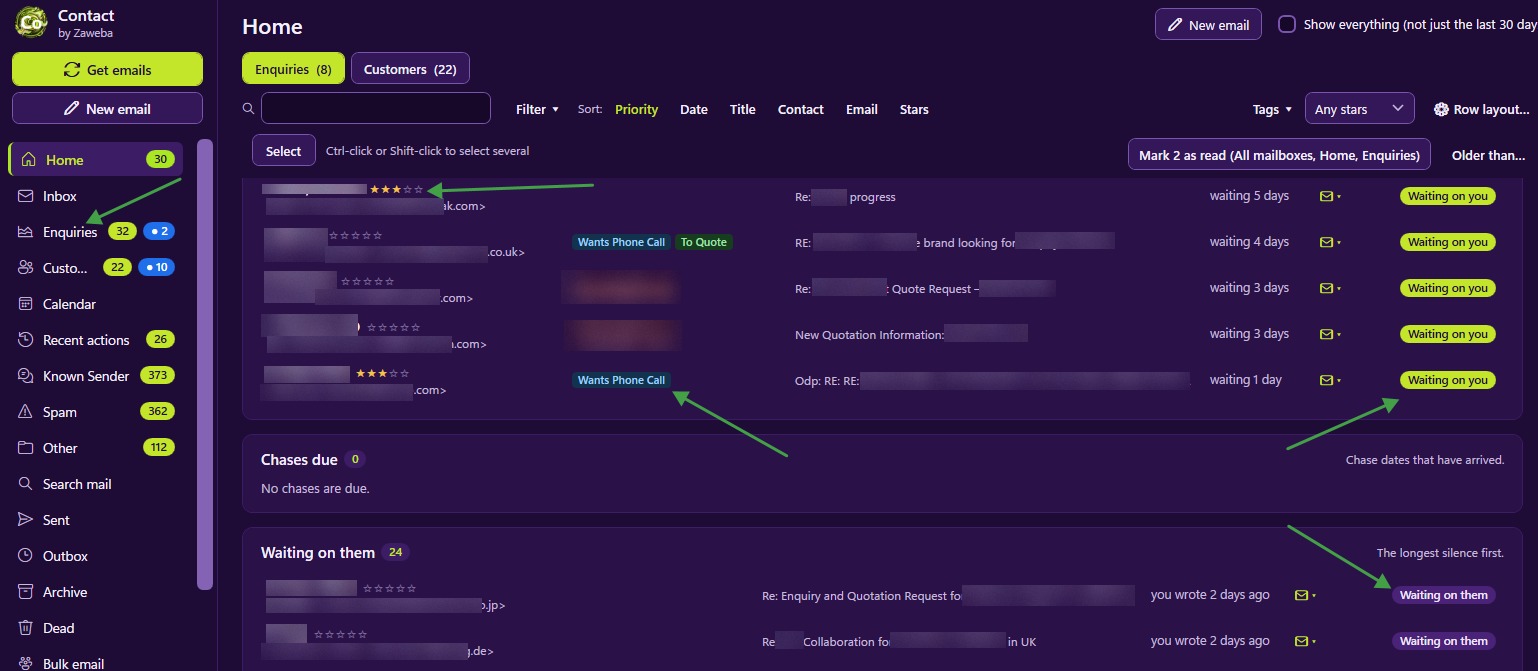
Use the command the moment you spot something odd, rather than letting stray emails build up. Status, chase dates and the Home view all depend on mail being in the right place, so one misfiled email can make a record look as though it is waiting on you when it isn't.
Read the explanation before you choose a fix. It often shows the cause is a contact you added months ago and forgot about, and that is quicker to sort at the source.
Because everything goes through Recent actions, you can try a fix, look at the result and undo it if needed. That makes it a safe command to reach for, even when you are not sure which answer is right.