
How Disk Sort's cleanup suggestions measure wasted space
The CLEANUP tab in Disk Sort by Zaweba measures temp files, caches, node_modules, old installers and more. It only measures; you choose what goes.
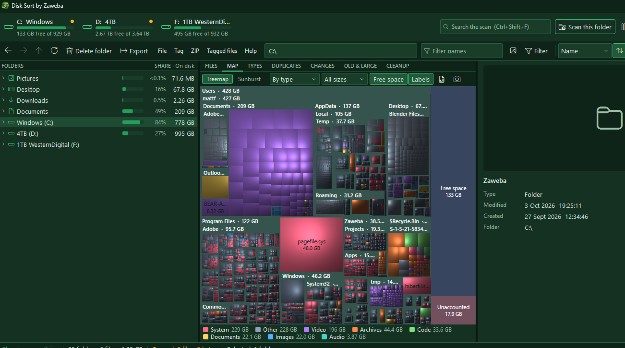
Most drives carry space that nobody chose to keep: temporary files, caches, leftovers from updates. The CLEANUP tab in Disk Sort by Zaweba measures these typical space users and shows how much each one holds. It's built around a simple rule. It measures, and you decide. Nothing goes until you've tagged it and confirmed.
What it looks at
The tab checks the places that commonly grow without anyone noticing. Temp files, which programs create while they work and often forget to remove. Browser caches, which store copies of pages and pictures so sites load faster. node_modules folders, which developers will recognise as the large folders of downloaded packages that JavaScript projects create. Old installers in Downloads. The Recycle Bin. Windows Update leftovers. Crash dumps, which Windows and programs write when something goes wrong.
Some of these are a few megabytes. Others, on a busy PC, run to many gigabytes.
Why it only measures
Cleanup tools that delete things automatically make an assumption about your files. Usually the assumption is right; occasionally it isn't, and the result is a lost download or a broken project. Disk Sort doesn't make that assumption for you. The CLEANUP tab tells you where the space is, and the decision stays with you.
When you do want something gone, you tag it and confirm. Deletes go to the Recycle Bin, with a confirmation showing counts, a preview and anything that's blocked, so a mistake can be undone.
Places Windows looks after
Some of these locations are managed by Windows itself, and changing them by hand isn't wise. For those, Disk Sort points you to Windows' own tools rather than touching them. Windows Update leftovers are the obvious example.
The Recycle Bin is measured too, but Disk Sort never empties it. Emptying the bin is the moment deleted files become hard to get back, so that step stays with you in Windows.
Working through the list
Start with the biggest figure. The tab shows totals, so the order of work is clear.
For browser caches, remember that a browser rebuilds its cache as you browse. Clearing it frees space now, and some of that space will come back. It's still worth doing when a cache has grown large, but it isn't a permanent fix.
For old installers, look at names and dates before tagging. Anything you might need to reinstall offline is worth keeping or moving to another drive instead.
For node_modules folders, check which projects they belong to. A folder in a project you've finished with is fair game; one in a project you're working on today will simply be downloaded again next time you build.
For temp files, close running programs first, since some will be in use. The confirmation lists anything that's blocked, so you can see what was left alone.
How it fits with the rest
CLEANUP sits beside the other disk tools. The folder tree with size bars and the MAP tab show where space is by folder. TYPES shows it by kind of file. DUPLICATES finds identical copies. OLD & LARGE lists big files that haven't changed in months. Between them, they cover most of the reasons a drive fills up.
After a clear out, press Ctrl+F5 to rescan, and the CHANGES tab can show you next time which folders have grown back.
Safety underneath
Every delete in Disk Sort by Zaweba asks first. Windows, Program Files and other protected system folders are blocked, as is the root of any drive. Drives without a Recycle Bin are refused rather than wiped. Cleanup is a place where a careful tool earns its keep.

