
Extracting files from archives in Disk Sort by Zaweba
Disk Sort by Zaweba extracts one archive, all of it or just the tagged files, with a New folder button and an option to move the ZIP in afterwards.
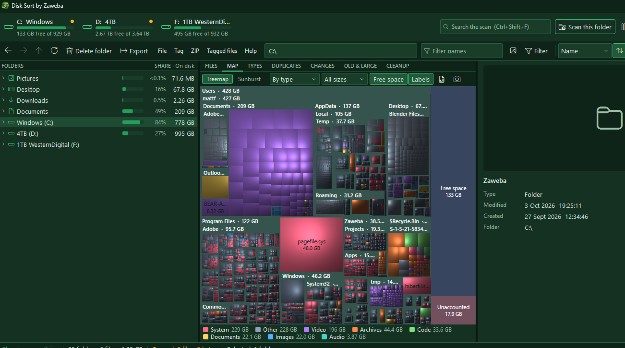
Archives open as folders in Disk Sort by Zaweba, so you can look inside before deciding anything. When you want the files out, there are three ways to do it: Extract to from the right-click menu, Extract all to for the whole archive, and Extract tagged files for just the ones you've picked. Each opens a window where you choose the destination, with a New folder button and an option to move the ZIP into that folder too once it's done.
Looking before extracting
ZIP, 7z, RAR and TAR files all appear in the folder tree as folders. Open one and its contents show in the file list like any other folder, with names, sizes and dates. A Files inside column and sort show how many files each archive holds, which is useful in a Downloads folder full of them.
This step saves a lot of clutter. Plenty of archives contain one useful file and a stack of extras. Others turn out to be copies of something already extracted next to them. Looking first means you only take out what you need.
If you open a file from inside an archive to check it, it's copied read-only to a temporary folder first, so the archive itself isn't changed.
Extract everything
Extract all to takes the whole archive. It's the right choice for a set of photos someone sent, a project's files, or anything where you need the full contents in their original folder structure.
Make a new folder for it from the Extract window rather than extracting straight into a busy folder. It keeps the contents together and makes it obvious later where they came from.
Extract only some files
Extract tagged files takes only what you've tagged. Open the archive, tag the files you want with T (or everything shown with Ctrl+T, after filtering), and extract. It's ideal for a large archive of manuals where you want one, or a photo archive where you only need a few pictures.
Moving the ZIP in afterwards
The option to move the ZIP into the folder after extracting tidies up in one step. The archive and its contents end up together in the new folder instead of the archive sitting loose in Downloads. You can then decide later whether to keep the archive, which is handy if you might need to send it on again, or delete it to free the space.
Archives are worth checking when space is tight. The TYPES tab totals a folder by extension, so you can see how much space archives take overall. An archive that's already been extracted is often a pure duplicate. Once you've checked the extracted copy is complete, the archive can go to the Recycle Bin.
Making archives
Disk Sort can make archives as well as read them. Z or Add to ZIP compresses selected files, and the ZIP menu makes a ZIP of the tagged files or adds them to an existing one. Writing is ZIP only, so 7z, RAR and TAR can be opened and extracted but not created.
A careful finish
Extracting writes new files, so it follows the same care as every file action in Disk Sort by Zaweba. Protected system folders and drive roots are blocked. For more work on a ZIP itself, ZIP by Zaweba is the suite's dedicated archive tool.

