
Reading the folder tree and its size bars in Disk Sort
The folder tree in Disk Sort by Zaweba shows a size bar, share and size beside every scanned folder, with keys for opening, closing and sorting.
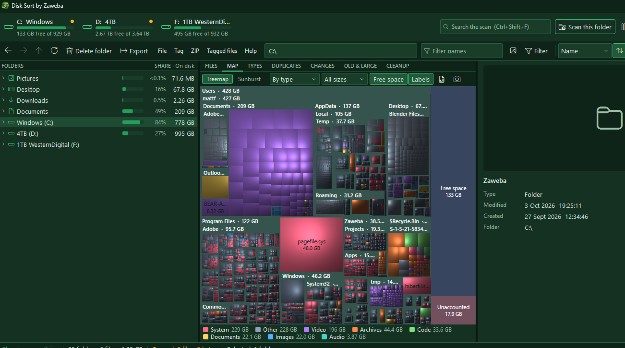
On the left of Disk Sort by Zaweba sits a folder tree, one line per folder, and it's where most of your time goes. Before a scan it's a plain, fast way to move around your drives. After a scan it becomes a disk space analyser too, with a size bar, a share of the parent and a size on every scanned line.
What each line tells you
The size bar is the quickest read. A long bar means that folder holds most of what its parent holds. The share figure puts a number on it, so a folder at 70 percent of its parent is clearly where to look. The size itself tells you whether it matters at all; 90 percent of a tiny folder is still tiny.
Read the three together as you go down. Open the drive, find the line with the longest bar, open that, and repeat. In a few steps you usually reach the folder that's actually responsible: a forgotten video export, a phone backup, a games library or a download folder that never gets cleared.
At the top of the tree, places such as Pictures and Documents are listed, so the folders you use most are always one click away.
Sorting by name or by size
Click FOLDERS at the top of the tree to sort by name, which is easiest when you know what you're looking for. Click SHARE to sort biggest first, which is what you want when you're hunting for space. Switching between the two as you work is normal: biggest first to find the culprit, then by name to find a particular folder beside it.
Moving around with the keyboard
The tree is built to be driven from the keyboard. Right opens a folder and Left closes it. The star key, *, opens everything below the current folder in one go, which is handy for seeing the whole shape of a branch. Enter opens the folder, and Backspace or Alt+Up goes up a level.
With those keys your hands stay in one place while you work down through a drive, which matters when you're checking dozens of folders.
Archives as folders
ZIP, 7z, RAR and TAR files appear in the tree as folders you can open. That makes it easy to see what's inside an old archive without extracting it first, and to judge whether it's worth keeping. A file you open from inside an archive is copied read-only to a temporary folder first, so the archive itself isn't touched.
Working from the tree
The tree isn't only for looking. In the tree, T and U tag a folder's files, and Ctrl+T and Ctrl+U tag or untag the whole branch. F2 renames a folder, and the tags, history and scan follow the new name. Del starts a delete, and the confirmation shows how many files and folders the folder holds and their size before anything goes to the Recycle Bin.
You can also drag files from the list onto a folder in the tree to move or copy them. On the same drive that moves them; to another drive it copies. Holding Ctrl copies and Shift moves, whatever the drive.
A good routine
Start with SHARE sorting and the drive's top level. Follow the longest bars down two or three levels and note what you find. Then decide what kind of problem it is. A folder of photos goes to the Files tab for culling with keepers and stars. A folder of near identical copies goes to the DUPLICATES tab. A pile of old installers or caches is a job for the CLEANUP tab. The tree is the map you navigate by while the other tabs do the clearing.

