
How to free up space on Windows 11 safely
Find the space hogs on Windows 11 with Disk Sort by Zaweba, which measures temp files and caches first and only deletes to the Recycle Bin after you confirm.
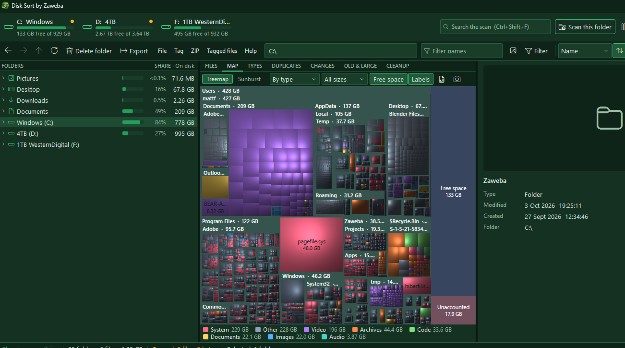
The safest way to free up space on Windows 11 is to measure first and delete second, and Disk Sort by Zaweba is built to work in that order. Its CLEANUP tab measures temp files, browser caches, old installers and other usual space users without touching them. You then tag what you want gone, check the list and confirm, and the files go to the Recycle Bin rather than vanishing.
Speed matters less than care here. A full drive tempts people into deleting whole folders they do not recognise, and some of those belong to Windows or to programs that need them. A tool that only measures until you say otherwise takes the guesswork out.
Before you delete anything
Open Disk Sort and click your system drive in the strip at the top. The scan fills the folder tree with size bars, and the MAP tab draws the drive as a treemap so the biggest folders are the biggest blocks. Spend a minute looking. Often the answer is obvious: a video folder, a backup someone forgot, or a games library.
If the drive filled up recently, the CHANGES tab is worth a look. After every full scan Disk Sort saves a snapshot of folder totals, and CHANGES compares the current scan with that snapshot, listing folders that grew or shrank. You need at least one earlier scan for this, so it pays to scan now and again even when the drive is fine.
Working through the cleanup tab
CLEANUP measures temp files, browser caches, node_modules folders, old installers in Downloads, the Recycle Bin, Windows Update leftovers and crash dumps. Each line shows how much space that category is using. Nothing is removed at this stage.
For the categories you are happy to clear, tag the items and review them. Temp files and browser caches are usually the easiest wins, although a browser will rebuild its cache over time and you may need to sign in to some sites again. Old installers in Downloads are files you have already run, so they are rarely needed again. node_modules folders matter only if you write software, and can be rebuilt by the project that made them.
Some places are managed by Windows itself, such as Windows Update leftovers. For those, Disk Sort points you to Windows' own tools rather than deleting the files itself, because Windows knows which pieces are still in use. The Recycle Bin line simply tells you how much it holds. Disk Sort never empties it, so emptying it remains your decision.
Bigger wins: duplicates and forgotten files
Cleanup categories are often smaller than personal files. The OLD & LARGE tab lists files over a size you choose that have not changed in a chosen number of months, which brings up forgotten videos, disc images and archives. DUPLICATES finds identical files above a minimum size, and Confirm byte by byte compares the actual bytes after the hashes match. You can tag the newest, oldest or shortest path copy in each set and act on the rest.
The TYPES tab totals the open folder by type and extension, which is a quick way to see whether video, pictures or something else is the real problem.
What makes the deleting safe
When you press Del, the Delete button or Ctrl+D for tagged files, Disk Sort shows a confirmation with counts, a preview and anything blocked. Items go to the Recycle Bin, so you can restore them if you change your mind. Drives without a bin, and items too big for it, are refused rather than deleted.
Windows, Program Files and other protected system folders are blocked, and so is the root of every drive. You can lift the folder block in Options, but a drive root stays blocked even then. Leave that option off unless you have a specific reason.
There is a Permanent delete (Shift+Del) that skips the Recycle Bin, with its own warning that it cannot be undone. On a drive you are trying to tidy safely, stick with the ordinary delete, check that everything still works for a few days, and only then empty the Recycle Bin yourself to get the space back.

