
Saving a disk space report or map from Disk Sort
Save Disk Sort by Zaweba's map as a PNG, or a report as HTML or CSV with top folders, top files and space by type, to keep or share.
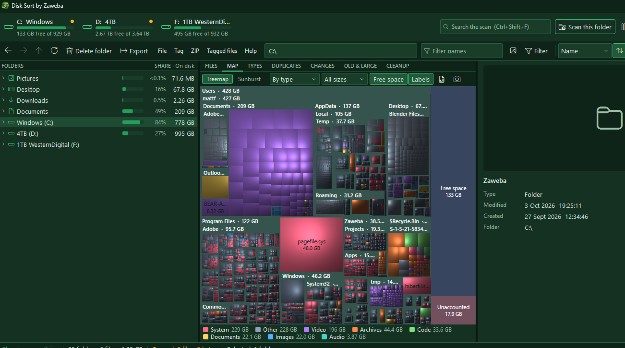
A scan in Disk Sort by Zaweba tells you a great deal while it's on screen. Saving it lets you keep that picture for later, send it to someone, or compare it with a future scan by eye. There are three outputs: the map as a PNG picture, a report as HTML or CSV, and the file list as CSV.
What goes in a report
A report covers the three things people most often want to know about a drive: the top folders, the top files, and the space taken by each type of file. In other words, where the space is, which individual files are the biggest, and what kind of thing is filling the drive, whether photos, videos, installers or something else.
Saved as HTML, it's a page you can open in any web browser and read like a document. Saved as CSV, it's a plain table that opens in a spreadsheet, where you can sort, filter and total it as you like. It's the format to choose when you want to work with the numbers rather than just read them.
Saving the map
The MAP tab shows every scanned folder as a treemap or, after pressing V, a sunburst. Saving it as a PNG gives you a picture of the drive's shape. It's useful in a few ways. You can keep one before a big clear out and another afterwards to see the difference. You can send one to whoever looks after a family computer to show why it's slow and full. And it's a handy record when you're deciding what to buy as a second drive.
The map can be coloured by file type, by age or by growth since the previous scan, so set the colouring you want before saving. A map coloured by age makes it obvious how much of a drive is old files nobody has touched in years.
Saving the file list
The file list itself, in the Files tab, can be saved as CSV. That's whatever the list is showing at the time, so you can shape it first. Filter it to one kind of file, sort it by size, switch to a flat list of everything in a branch, or show only tagged files, then save. The columns you see, such as name, size, modified date, type and, for photos, camera and date taken, give you a detailed inventory.
Uses for a saved report
Planning a move to a new drive. A CSV of top folders tells you how much you're moving and where it lives.
Clearing a work or family PC with someone else. An HTML report is easy to read without installing anything, so the other person can say what's safe to go before you touch it.
Keeping a record of a photo archive. A CSV of a picture folder with date taken and camera columns is a simple catalogue you can search in a spreadsheet.
Tracking growth over months. Disk Sort's CHANGES tab already compares with the previous snapshot, but saved reports let you keep a longer history.
Getting the most from it
Scan before you save. A report is only as current as the scan it comes from, so press Ctrl+F5 to rescan everything if a lot has changed, or F5 to refresh the folder you're in.
Decide between size and size on disk first. F4 switches how sizes are shown. Size on disk reflects the space files really take, which is usually what matters for a full drive.
Save from the right folder. A report on a whole drive is a summary; a report on one heavy folder is a detailed look. Both are useful, for different questions.
Everything stays on your PC. Disk Sort by Zaweba works offline, so reports and maps are only ever written where you choose to save them.

