
How to scan a network drive or folder for sizes
Use Scan this folder (Ctrl+O) in Disk Sort by Zaweba and pick the network share; the standard scan works on any file system and needs no admin rights.
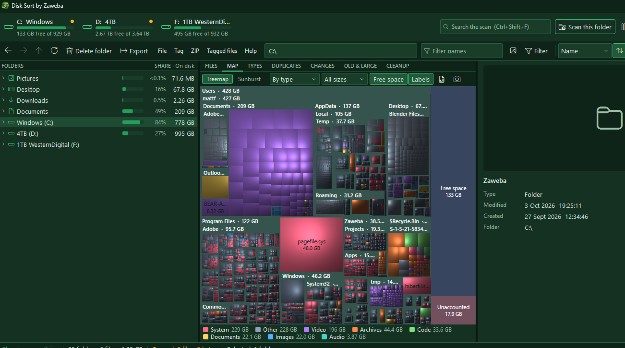
In Disk Sort by Zaweba, choose Scan this folder (Ctrl+O) and pick the network share or the folder you want to measure. The standard scan works on any file system without administrator rights, so a shared drive, a NAS or a folder on another computer is measured the same way as a local one. When it finishes, every folder in the tree shows a size bar, its share of the parent and its size.
Shared drives fill up quietly. Several people save to them, nobody owns the clutter, and the first anyone hears of it is a message saying the share is full. A scan turns that into a picture you can act on.
Starting the scan
Local drives sit in the strip at the top of the window and scan with a click. A network location is reached through Scan this folder instead. Press Ctrl+O, browse to the share or a folder inside it, and start. The scan reads folders in parallel, so even a large share comes back in reasonable time, although a network is always slower than a local disk.
You do not have to scan to look around. The folder tree works without a scan, and Open without scanning on the right-click menu lets you browse a folder first. When you know which part interests you, Open and scan on the same menu adds the size layer to just that part. On a big share, scanning one department's folder rather than the whole thing saves time.
Reading the results
Each scan adds a size layer to the tree. Click SHARE to sort folders biggest first, then open the top one and repeat. Within a few clicks you usually reach the folder that matters.
The MAP tab shows the same scan as a treemap, with rectangles sized by space. Big files and folders stand out as big blocks, and double-click or Enter zooms in. Press V for a sunburst if you prefer rings by folder level. You can colour the map by file type, which often shows at a glance that one kind of file is taking most of the space.
For the numbers behind that, the TYPES tab totals the open folder by file type and extension. Click a row to list those files.
Sizes can be shown as plain size or as space on disk, switched with F4. On a share the difference depends on how the server stores files, so use whichever matches the question you are asking.
Keeping it up to date
F5 refreshes the open folder, and Ctrl+F5 rescans everything. After every full scan Disk Sort saves a snapshot of folder totals, so the next time you scan the share, the CHANGES tab can list folders that grew or shrank since. That is often the quickest way to answer who filled it up this month.
If the share has junctions or links that point elsewhere, there is an option to follow them. Leave it off unless you need it, so a link does not lead the scan into a second copy of the same data.
Acting on what you find
Network drives behave differently from local ones when you delete. Disk Sort sends deletes to the Recycle Bin and first checks that Windows really would recycle them, and drives without a bin are refused rather than deleted. Network shares usually fall into that group, so an ordinary delete there is turned away. Permanent delete (Shift+Del) does work on network drives, with its own confirmation saying it cannot be undone, so be sure before you use it on shared files.
A gentler route is to tag the old material and move it to an archive drive. Copy and move ask first with counts, and moving to another drive copies, checks that everything arrived and only then removes the original.
The fast index scan is for local NTFS drives only, so on a share Disk Sort by Zaweba always uses the standard scan, and that needs no special rights.

