
How to search every file on a scanned drive by name
Press Ctrl+Shift+F in Disk Sort by Zaweba to search the names in a scan; matches appear in the Results view, ready to open, tag, move or delete.
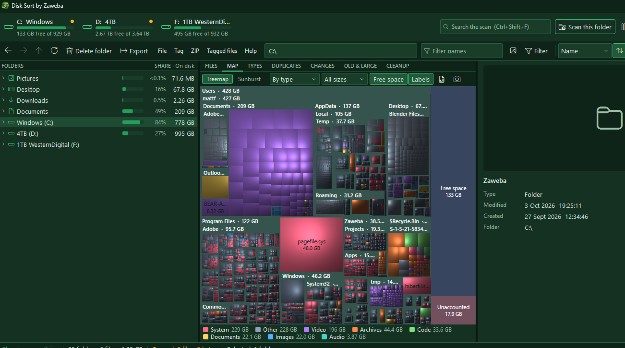
Once a drive has been scanned in Disk Sort by Zaweba, press Ctrl+Shift+F to search the names in that scan. Matches are listed in the Results view, looking in the open folder, so open the drive itself to search all of it or a single folder to search just that part. From the Results list you can open, tag, copy, move, rename or delete the files like any others.
Searching a scan is quick because the names are already in memory. The program does not have to walk the disk again for every search, which makes it comfortable to try several names in a row when you are not sure what a file was called.
Searching a whole drive
Scan first. Click the drive in the strip at the top, or use Scan this folder (Ctrl+O) for a folder or a network share. Then select the top of the drive in the folder tree, so the search looks everywhere the scan reached, and press Ctrl+Shift+F.
Type part of the name. Results appear in their own view in the FILES tab, and the detailed list (Ctrl+2) shows where each file is, its size, modified and created dates and its type. Sort by any of those to bring the likely candidate to the top, newest first if you remember saving it recently.
Search versus the name filter
Disk Sort has two name tools, and they answer different questions. The search (Ctrl+Shift+F) looks through the scanned data below the open folder and gathers matches from anywhere in it. The name filter (Ctrl+F) narrows whatever list is already showing, and accepts * and ? wildcards.
The two work well together. Search for a word, then use the kind filter to show only documents or pictures among the results, or the name filter to narrow them further. Showall (S) is another route: it lists every file in the scan flat, and with the name filter on top, it behaves like a search across the drive.
What to do with the results
Enter opens a file, Ctrl+Enter opens it with the Windows default program, and Shift+Enter shows it in Explorer. Open with on the right-click menu lists installed Zaweba apps that edit or view it.
To gather files from all over the drive, tag the results you want with T, or Ctrl+T to tag everything shown. Tags stay in place while you search for something else, so you can build a set from several searches and see it all with G. Then copy or move the tagged set to one folder, zip it, or burn it with Burn by Zaweba if that is installed.
If the search turns up several copies of the same thing, the DUPLICATES tab is the better tool for deciding which to keep. It finds identical files for a minimum size, with Confirm byte by byte to compare the actual bytes after the hashes match.
When a file does not show up
The search covers what the scan has seen. If a file was saved after the scan, press F5 to refresh the open folder, or Ctrl+F5 to rescan everything. On a local NTFS drive with Disk Sort running as administrator, the fast scan keeps up with changes as they happen, so new files appear without a rescan.
Check that the right folder is open, as the search looks in the open folder and below, and that no filter is hiding the results. Clear all filters resets them.
Disk Sort by Zaweba is free and offline. The scan and the search both stay on your own computer.

