
Seeing space by file type with Disk Sort by Zaweba
The TYPES tab in Disk Sort by Zaweba totals a folder by file type and extension; click a row to list those files and right-click to tag them.
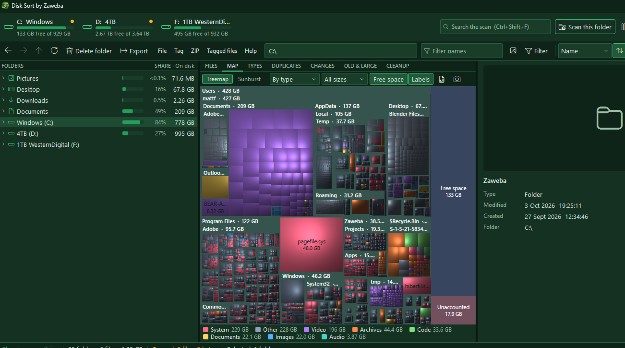
Knowing which folder is big is half the story. The other half is what kind of thing is making it big, and that's the job of the TYPES tab in Disk Sort by Zaweba. It totals the open folder by file type and by extension, so you can see at once whether your space has gone on videos, photos, installers, archives or something you'd never have guessed.
Reading the totals
Open a folder in the tree, or the top of a drive, and go to TYPES. Each row is a type or an extension with the space it uses. Videos often top the list on a home PC; on a work machine it may be disk images, design files or old installers.
The numbers come from the scan, so scan first. If you've just moved or deleted a lot, F5 refreshes the folder and Ctrl+F5 rescans everything.
The breakdown changes with the folder. A drive's top level gives the overall picture. A single heavy folder found through the size bars gives a detailed look at what that folder is made of, which is often more useful.
From a row to the files
Click a row and Disk Sort lists those files. Click the row for MP4, and every MP4 file in the open folder and below appears in the file list, where you can sort by size, check dates and look at them. Right-click a row to tag all of those files at once.
This is the point where looking turns into doing. With a type's files listed or tagged, every file action is available: copy with C, move with M, zip with Z, or delete to the Recycle Bin with a confirmation that shows counts and a preview.
Workflows that start here
Moving videos to a second drive. Go to TYPES at the top of the full drive and click the video row. Sort the list by size, check you aren't moving anything a program depends on, tag the ones to go, and move them. Moving to another drive copies everything, checks it arrived, and only then removes the originals.
Clearing out installers. Downloads folders collect setup files that are never needed again once a program is installed. Open Downloads, go to TYPES, click the installer extensions, and look through the list. Older ones are usually safe to remove, though it's worth keeping any you might need to reinstall something offline.
Packing up archives. If the breakdown shows a lot of space in ZIP, 7z or RAR files, open a few as folders in the tree to see what's inside before deciding. Some will be duplicates of folders that are already extracted next to them.
Separating raw and finished photos. On a photography drive, the breakdown by extension shows how much space goes on camera originals compared with exported JPGs, which helps when you're deciding what to archive.
Using it with the other tools
TYPES is one of several tabs that look at the same scan from different angles. The MAP tab can be coloured by file type, which shows where a type sits on the drive rather than how much of it there is. The DUPLICATES tab finds identical copies, and the OLD & LARGE tab finds files over a chosen size that haven't changed in a chosen number of months. A saved report, as HTML or CSV, includes space by type alongside top folders and top files.
A word of care
A file type isn't a verdict. A big total for one extension may be a program's own data, which belongs where it is. Windows, Program Files and drive roots are protected from changes, but other program folders aren't, so look at where files live before acting on them all.
Used this way, the TYPES tab in Disk Sort by Zaweba turns a vague sense that the drive is full into a clear list of what to deal with first.

