
How to see which file types use the most space
The TYPES tab in Disk Sort by Zaweba totals a folder or drive by file type and extension, and one click lists every file of that type to tag or move.
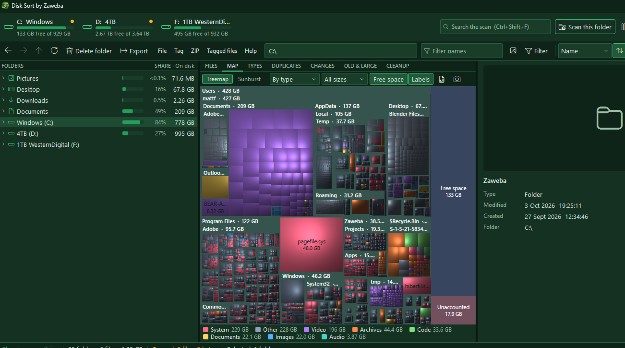
Scan the drive in Disk Sort by Zaweba, open the folder you care about, and look at the TYPES tab. It totals that folder, and everything below it, by file type and by extension. Click a row and the files of that type are listed, ready to tag and move, zip or delete.
Knowing which folder is big is only half the story. Often the useful question is what kind of thing is big. A drive might be full of video from a phone, or of disc images, or of installers that were never cleared out, and the type breakdown shows that in one view.
Getting a breakdown
Click a drive in the strip at the top or use Scan this folder (Ctrl+O). When the scan finishes, select a folder in the tree. The drive itself works for the whole picture, while a single folder such as Pictures or Downloads gives a narrower answer. Then open TYPES.
The list totals the open folder by file type and extension, with the size of each. It is common to find that one or two types account for most of the space and everything else is small change.
From a row to the actual files
Click a row to list those files. They appear in the FILES tab, where you can switch between thumbnails (Ctrl+1) for pictures and video, or the detailed list (Ctrl+2) with name, size, on disk, modified and created dates. Right-click a row in TYPES to tag them all at once.
Tagged files can be anywhere on the drive. Press G to see every tagged file in one list, then copy, move, zip or delete them together. Moving a type of file off a full drive, such as every video to an external disk, becomes a single operation. Every copy and move asks first with counts, and moving to another drive checks that everything arrived before removing the original.
Seeing types on the map
The MAP tab can colour the treemap by file type. Instead of reading a table, you see where each type lives: a patch of one colour in a corner might be a video folder, a scattering of another colour might be photos spread over many folders. Double-click a block to zoom in and see which folder it is.
The same map can be coloured by age, which helps when you are deciding whether a big type is still in use, and by growth since the previous scan.
Other ways to narrow it down
When you already know the kind of file you want, the kind filter shows only one kind in the file list, such as pictures, video, music or documents, while folders always show. The name filter (Ctrl+F) accepts * and ? wildcards, so a pattern for one extension works too.
Showall (S) lists every file in the scan flat, biggest first if you sort by size, and Branch (B) does the same for the open folder and everything below it. Combined with a filter, that gives the biggest files of one type across the whole drive.
The OLD & LARGE tab is a good partner to TYPES. It lists files over a chosen size that have not changed in a chosen number of months, which separates the big files you still use from the ones you forgot.
Disk Sort by Zaweba is free and runs offline. Sizes can be shown as plain size or as space on disk (F4), and every delete goes to the Recycle Bin after you confirm.

