
Download with confidence, then keep your Downloads folder in order
How to download software safely on Windows, what easy to install should really mean, and how to tidy the Downloads folder once it fills up.
Almost everything on a Windows PC arrives the same way: you click a link, a file lands in your Downloads folder, and you either open it straight away or forget it is there. Programs, PDFs, photos from friends, invoices, phone backups, installers for printers you no longer own. Over months and years, that one folder quietly becomes the biggest junk drawer on the computer.
This article covers both halves of the job. First, how to download things safely and sensibly, including what to look for when a program claims to be free to download and easy to install. Second, how to deal with the pile that builds up afterwards, using a few plain habits and a free tool from our own suite that is well suited to the clearing-out part.
What actually happens when you download something
A download is simply a copy of a file travelling from someone else's computer to yours. Your browser fetches it, saves it to a folder (usually the Downloads folder inside your user folder) and, in most cases, shows it in a small list of recent downloads.
At that point nothing has been installed and nothing has run. The file is just sitting there. That is worth remembering, because it means the moment of real decision is not when you click the link but when you open the file. A downloaded document or picture is usually harmless to look at. A downloaded program is different: when you run it, you are giving it permission to make changes to your PC.
Most browsers let you choose whether they save automatically to Downloads or ask you each time. If you like to keep things organised from the start, asking each time lets you send a file straight to the right place, such as a project folder or your Documents. If you prefer speed, leave it saving to Downloads and plan to tidy up regularly, which is what most people do.
Downloading safely: habits worth keeping
You do not need to be an expert to download safely. A handful of small habits cover most of the risk.
Get software from the people who made it
The safest place to download a program is the developer's own website. Third-party download sites sometimes wrap a genuine program inside their own installer, adding extra offers or toolbars along the way. If you search for a program by name, look carefully at the address before clicking, and be wary of sponsored results that sit above the real site.
Check the file before you open it
Look at the file name and the file type. A photo should not end in .exe. A PDF should not need to be installed. If something you expected to be a document turns out to be a program, delete it rather than open it.
For programs, you can right-click the file and choose Properties. Signed programs have a Digital Signatures tab that shows who published them. Not every honest small developer signs their files, so a missing signature is not proof of anything bad, but a signature from a name you do not recognise is a good reason to pause.
Take Windows warnings seriously
Windows may show a warning when you run a program it has not seen much of before. That can happen with perfectly good software from small developers, but it is still a moment to stop and ask yourself whether you trust where the file came from. If you went to the developer's own site on purpose, you are in a far better position than if the file arrived unexpectedly in an email.
Read the installer screens
The habit of clicking Next, Next, Next is how most unwanted extras end up on a PC. Read each screen. Look for pre-ticked boxes offering other programs, changes to your browser's home page or a different search engine. Untick anything you did not ask for.
What easy to install should really mean
Plenty of programs describe themselves as easy to install. In practice, that phrase should mean a few specific things, and it is fair to judge any download against them.
- No account needed. You should not have to sign up, confirm an email address or log in just to start using a program on your own computer.
- No surprises. An installer should install the program you asked for and nothing else.
- Clear choices. If there is a choice to make, such as where to install or whether to add a desktop shortcut, it should be explained in plain words.
- Works afterwards without fuss. Once installed, the program should open and be usable straight away, ideally without needing an internet connection.
- Easy to remove. A program that is easy to install should also appear properly in the list of installed apps in Windows Settings, so you can uninstall it cleanly if you change your mind.
If a download fails several of these, that tells you something about how the people behind it think about your computer.
Free to download, free for everyone
The word free gets stretched a long way online. A program can be free to download but then ask for an account, show adverts, collect information about how you use it, or keep your files on someone else's server. None of that is necessarily hidden, but it is not what most people picture when they read the word.
Zaweba works differently, and it is worth being plain about how. Every Zaweba app is free for everyone. There is no sign-up, no adverts and no telemetry. The apps work offline and keep your files on your own PC. When you download one, what you get is the program itself, and the work you do with it stays with you.
We mention this not as a sales pitch but because it is a useful yardstick. When you are deciding whether to download anything, ask the same questions: Do I need an account? Will it show me adverts? Does it send information about me anywhere? Where do my files end up? A program that answers all four in your favour is one you can install with a clear conscience.
Where your downloads go, and why the folder fills up
The Downloads folder fills up for understandable reasons. It is the default destination for almost everything, so it collects files of every kind. Most people open a file from there, use it once, and never think about it again. Installers in particular are easy to forget, because once the program is installed the original file has done its job but is still taking up space.
Typical things you will find in an old Downloads folder include:
- Program installers, sometimes several versions of the same one.
- The same PDF or photo downloaded two or three times, with (1) and (2) added to the name.
- Large video files sent by friends or family.
- ZIP files that were extracted long ago, with both the archive and the extracted folder still present.
- Disc images and phone or device backups that are far bigger than everything else put together.
None of this is a problem until the drive starts to run low on space or you need to find something important among hundreds of forgotten files. That is usually when people start deleting things at random, which is how important files get lost. A calmer approach is to look properly before you delete anything.
Sorting out the pile with Disk Sort by Zaweba
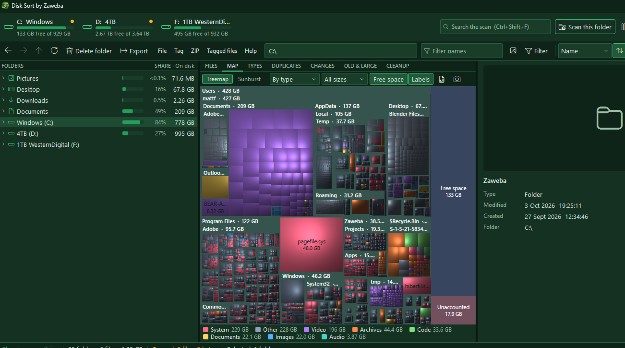
Disk Sort by Zaweba is a disk space analyser and photo sorter in one window. It shows where your space has gone using treemaps, where each folder and file is drawn as a block sized by how much room it takes, and it puts tools for finding duplicates and cleaning up beside tools for marking keepers with stars and tags and moving files safely. For a cluttered Downloads folder, and for the rest of a drive that has slowly filled up, it covers the jobs you actually need to do.
Duplicates and old files
The most satisfying first step is usually finding duplicates. Disk Sort can find duplicate files, so the three copies of the same manual or the two identical holiday videos show up together rather than hiding under slightly different names. It can also find old and large files, which is exactly where forgotten installers, disc images and big video downloads tend to sit.
It also gives a breakdown by file type, which is a quick way to see what the space is really being used for. If most of your Downloads folder turns out to be video, or installers, you know where to start.
The useful part is that the results are not a dead end. You can act on them like any other files: open them to check what they are, move the ones you want to keep, and remove the ones you do not. That matters, because a list of duplicates is only helpful if you can deal with it without hunting for each file separately.
Tag across folders
Downloads rarely stay in one place. Some get moved to Documents, some end up on the desktop, and some are buried in folders inside folders. Disk Sort lets you tag files anywhere on the drive, then copy, move, zip or burn them together.
Here is a practical way to use that. Suppose you want to gather every manual and receipt you have ever downloaded into one sensible folder. Work through the drive, tag each one as you find it, wherever it lives, and then move all the tagged files together into a single folder. The same idea works for gathering photos a relative sent at different times, or collecting everything belonging to one project before archiving it.
If you want to put tagged files into a single archive, the zip option gathers them in one go. For a disc to keep in a drawer, the burn option does the same job for physical media. If you work with archives a lot, ZIP by Zaweba can also check every file in an archive for damage, which is reassuring before you delete the originals.
See what changed
Clearing out once is good. Knowing when things are getting out of hand again is better. Disk Sort can compare a scan with an earlier snapshot to see which folders have grown since last time.
This is particularly handy for the Downloads folder, because it grows in fits and starts. A month after a big tidy, a new scan compared with the earlier snapshot will show you whether Downloads is creeping up again, or whether something else, such as a video folder or a backup location, is the real reason your free space has dropped. Instead of guessing, you can go straight to the folder that has changed.
Keeping the downloads that matter
Not everything in Downloads is rubbish. Among the clutter you will often find things that are genuinely hard to replace: scanned documents, tickets, letters, photos that exist nowhere else, or the only copy of a file someone sent years ago.
Before any big clear-out, it is sensible to move those into proper folders with clear names, such as Documents, Pictures or a folder for each household topic. Tagging them across folders and moving them together, as described above, makes this much quicker than dragging them one at a time.
Once important files are in their proper home, make sure they are backed up. Backup by Zaweba can mirror, echo or two-way sync folders to a USB stick, a second drive or a network share, with a preview first so you can see what will happen and old copies kept safe. A file that was only ever in Downloads is one accidental delete away from being gone; a file in a backed-up folder is not.
A simple routine for downloads
You do not need to think about your Downloads folder every day. A light routine keeps it under control without becoming a chore.
- When you download a program, get it from the developer's own site, read every installer screen and untick anything you did not ask for.
- Once a program is installed and working, delete the installer unless you have a good reason to keep it. You can always download it again.
- When you download a document you want to keep, move it to a proper folder straight away, while you still remember what it is.
- Once a month, run a scan, compare it with your last snapshot and see which folders have grown.
- Every few months, look for duplicates and old, large files, and clear out what you no longer need.
- Before deleting anything you are unsure about, check it is backed up, or gather such files together and archive them rather than deleting them outright.
The point of the routine is not to keep the folder empty. It is to make sure that the files in it are there because you chose to keep them, not because you forgot about them.
A few common questions
Is it safe to delete everything in Downloads?
Not without looking first. Most of it is usually safe to remove, but people often keep the only copy of something important there without realising. Sort, move what matters, back it up, then clear the rest.
Should I keep old installers?
Generally, no. If the program came from the developer's own site, you can download the latest version again when you need it. The exception is software that is no longer available anywhere, in which case keep the installer somewhere backed up rather than in Downloads.
What about files I downloaded more than once?
These are exactly what a duplicate search is for. Keep one copy in a sensible place and remove the rest. Checking that the files really are identical, rather than just similarly named, saves you from deleting a newer version by mistake.
Downloading is one of the most ordinary things anyone does on a computer, and it deserves a little care at both ends: choosing what you let onto your PC, and deciding what stays once it is there. Get your programs from the people who made them, prefer software that is free for everyone in the full sense of the word, and give the Downloads folder a proper look now and then. With a clear view of where your space has gone and a simple way to gather, move and archive files, keeping on top of it takes minutes rather than an afternoon.

