How to check proportions by flipping the picture
Flip your painting in Easel by Zaweba with the mirror view to catch lopsided faces and leaning buildings, without changing a single stroke.
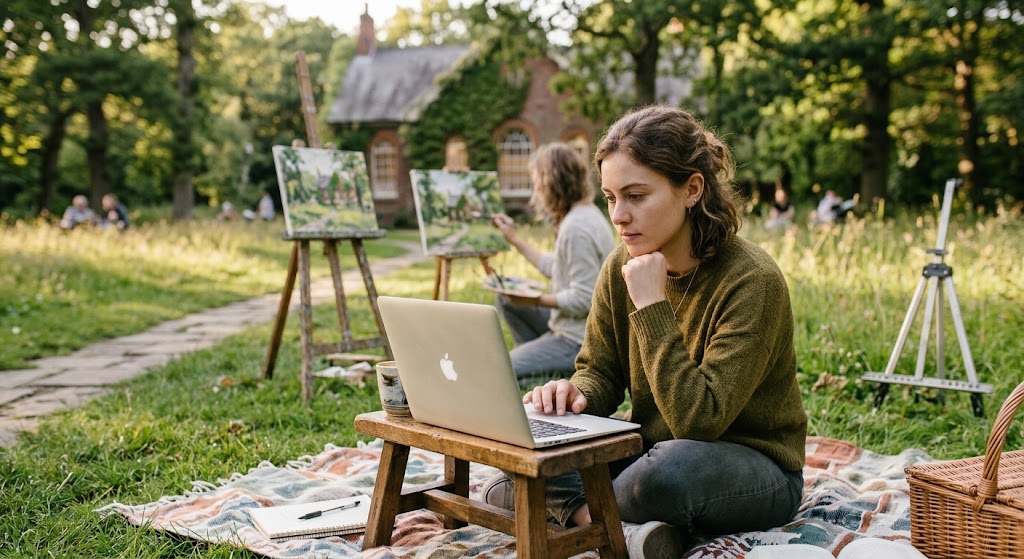
To check proportions by flipping the picture, turn on the mirror view in Easel by Zaweba. It shows your painting reversed left to right, so mistakes your eye has stopped seeing jump straight out. The flip is a view check only: it exists on screen and never touches the painting itself, so you can switch it on and off as often as you like.
Painters have done this for centuries with a hand mirror held over the shoulder. After an hour of looking at the same face, your brain quietly corrects what it sees, and a nose that drifts to one side starts to look normal. Reverse the image and the brain has to read it fresh. Whatever was off is suddenly obvious.
Why a reversed picture tells the truth
Most of us have a slight bias in the way we draw. A right-handed painter often lets verticals lean the same way, or makes one eye a little higher than the other, again and again. Because the error is consistent, it feels right. Flipping the picture moves the lean to the other side, where it no longer matches your habit, and it reads as wrong at once.
The same goes for composition. A landscape that seemed balanced can turn out to be heavy on one side, with the horizon sloping or the main tree crowding the edge. Symmetrical subjects such as faces, vases, bottles and arched windows are where the mirror earns its keep, because any difference between the two halves becomes plain.
Flipping, judging and fixing
Start painting as you normally would. Lay in the big shapes first, because that is the stage where proportions matter most and are cheapest to fix. Then switch on the mirror view and look at the whole picture for a few seconds without hunting for detail. Ask simple questions. Does the head sit straight on the neck? Are the eyes level? Does the building lean? Is the bottle's left shoulder fatter than its right?
Make a mental note of anything that jumps out, switch the mirror off and correct it in the normal view. Painting while flipped is possible, but most people find it easier to judge in the mirror and fix in the ordinary orientation, where their hand and eye are used to working together.
Because the mirror never changes the painting, there is nothing to undo and no risk of exporting a reversed picture by accident. It is purely a way of looking.
Pair it with the other view checks
Easel has two more checks that work the same way. The values view shows the picture in greyscale, which is the quickest way to see whether your lights and darks are doing their job once colour is taken out of the equation. The squint view softens the picture the way half-closed eyes do, so small detail drops away and the big masses remain. Running through mirror, values and squint in turn takes seconds and catches most of the problems that make a painting feel slightly wrong.
There is also Step back, which shows the picture from a distance, the digital version of walking to the far side of the room. Proportion errors that hide at close range often appear from across the room, so it makes a good partner to the mirror.
Habits that make the mirror useful
Check early and often. A flipped view in the first ten minutes can save an hour of careful rendering on a face that was never quite right. Once the drawing is sound, check again after each big stage, because proportions can drift as you add detail.
Look for a moment, not for ages. The mirror works because the image is new to you. Stare at the reversed version long enough and your brain adjusts to that too, so flick it on, take in what you see and flick it off again.
If you are working from a photo, the reference photo can sit beside the canvas or show as a faint tracing guide, and it is never merged into the painting. Comparing your flipped painting with the reference, also mentally flipped, is a demanding test, but it is very good practice for drawing from life.
The mirror view is a small tool, but it is one of the most useful habits a painter can build, and Easel makes it as quick as a glance.