Making a cyanotype print in Easel by Zaweba
Coat the paper, mask it, expose it to the movable light, then wash: the blue cyanotype sun print, step by step in Easel by Zaweba.
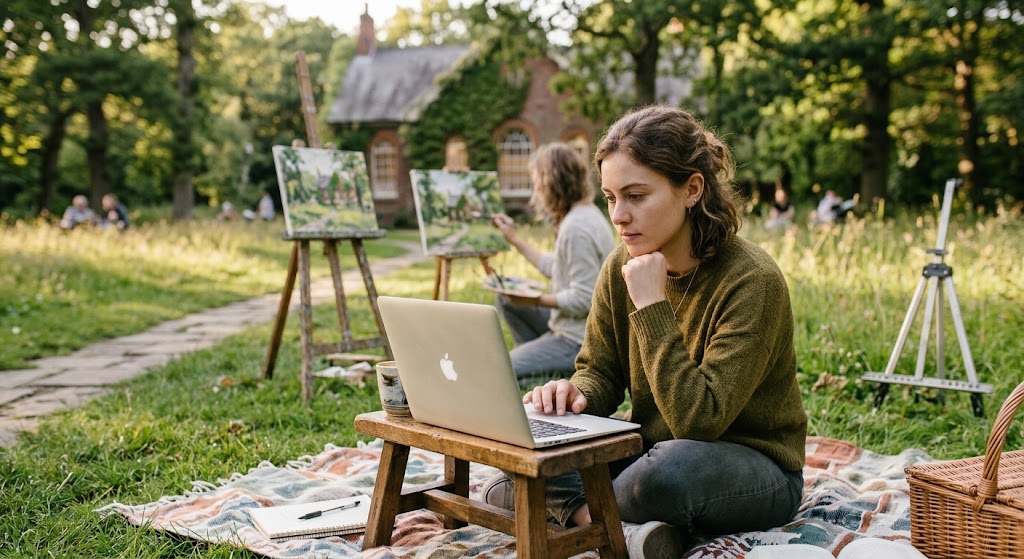
Cyanotype is one of the oldest photographic processes, invented in the 1840s. It is the deep blue print behind architectural blueprints and the botanical studies of Anna Atkins, who laid seaweed and ferns on treated paper and let the sun do the rest. Easel by Zaweba includes it, with the same four steps as the real thing: coat the paper, mask it, expose it to the movable light, then wash.
What makes cyanotype special is how simple the chemistry is and how striking the result. A single colour, Prussian blue, and the white of the paper are all it uses, yet the prints have a depth and calm that photographers and artists still love today. In Easel by Zaweba you get the same steps and the same blue and white look, with none of the mixing or waiting for a sunny day.
The four steps
Coat. In real cyanotype you brush a light sensitive solution onto paper and let it dry. In Easel you coat the paper in the same way.
Mask. Place something over the coated paper to block the light. Anything that blocks light leaves a pale shape, and anything that lets light through turns blue.
Expose. Turn the light on it. Easel uses its movable light for the exposure, the same light that shows impasto ridges on thick paint.
Wash. Washing develops the print. The exposed areas stay blue and the masked areas come out pale.
What to use as a mask
Easel already has a set of masking tools, and they all make natural cyanotype masks. Masking tape gives straight, hard edged strips, ideal for geometric designs. Masking fluid lets you paint a shape that stays white. Stencils, built-in or imported from any SVG, give clean shapes, and you can drag, resize and rotate one after it is down.
For a botanical print in the Atkins style, use stencils of leaves and ferns. For a modern graphic look, combine tape and stencils.
Choosing the paper
Watercolour papers are the traditional choice for real cyanotypes, because they stand up to washing. Hot-pressed paper gives smoother, crisper prints. Cold-pressed and rough give a softer, textured look. Easel's surfaces include all three.
Bold designs print best
Keep the design bold. Cyanotype is a two tone process, blue and white, so strong silhouettes work best. Fine detail can get lost.
Think about layering masks. A shape with tape over part of it, or a stencil laid over masking fluid, gives more than two values when combined with careful exposure.
Use the light thoughtfully. Because Easel's light is movable, with direction and height, think about where it falls before you expose.
Exposure is where a lot of the character comes from. Treat it as part of the design rather than a mechanical step, and make two or three prints from the same mask to compare the results before deciding which one to keep.
Where cyanotype fits
Cyanotype is a lovely change from paint. It produces a striking blue image with little effort and teaches how masking works. Once you have a print, you can draw or paint over it with white gel pen, gouache or ink, as many artists do with real cyanotypes.
It is also a good classroom project. Children and adults alike enjoy the moment the print appears, and in Easel by Zaweba you can try it as often as you like without chemicals, sunshine or a sink.