Can I leave living people out of a GEDCOM export?
Yes. Family by Zaweba's GEDCOM export has an option to leave out people who are probably alive, so you can share research without living relatives.
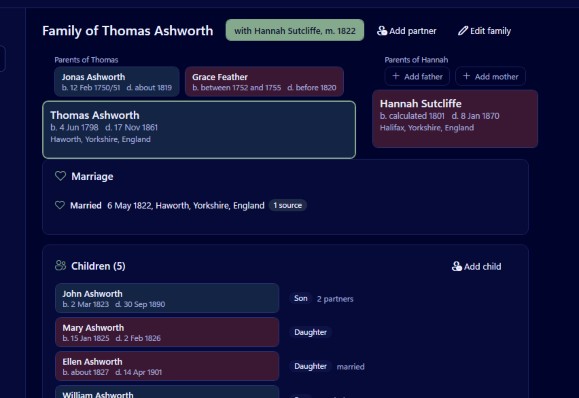
Yes. In Family by Zaweba, File, Export GEDCOM has an option to leave out people who are probably alive. Tick it and the file you send contains your ancestors and the dead of every branch, while living parents, siblings, cousins and children stay only in your own tree. The rest of the export works as normal, in GEDCOM 5.5.1 or 7.0.
It is one of the most useful options on that dialog, and one that is easy to forget until a relative asks why their date of birth is on someone else's website.
Why you might want to
Family history is mostly about the dead, but a working tree is full of the living. You add your brother so his children can be linked, your cousin so the branch makes sense, your own children because the tree is partly for them. All of that is fine on your own PC, where each tree is one .oft file that nobody else sees.
Sharing is different. A GEDCOM file can be imported into any family tree program and uploaded to online sites, and once you hand it over you have no control over where it goes. Names, birth dates and places of living people are just the kind of details that are better kept close. Leaving them out means you can say yes to a distant cousin asking for your research without thinking twice.
How to do it
Open the tree you want to share. From the File menu choose Export GEDCOM. Pick the version the other person's program reads best: GEDCOM 5.5.1 is the most widely understood and can be written as UTF-8 or UTF-16, while 7.0 is the newer standard and is written as UTF-8. If you aren't sure, 5.5.1 in UTF-8 is a safe default for most programs.
Turn on the option to leave out people who are probably alive, choose where to save the file, and export. Your own tree is not changed in any way: the option only affects what goes into the file.
If you have photos stored inside the tree, the export has another option to save them to a folder beside the file. Send the folder along with the GEDCOM and the pictures travel too.
What probably alive means in practice
The word probably is there for a reason. A tree rarely records a death for everyone who has died, especially in branches you have only sketched in. Family has to judge who is likely to be living from what the tree does hold. It is a sensible filter, not a guarantee.
So check the result before you send it. A quick way is to import the exported file into a new, empty tree in Family and look through the people list for anyone who should not be there. If someone slips through, it is usually because the tree has too little about them to tell. Adding a death, or a burial, for people you know have died makes the judgement more reliable for everyone.
The other direction
Sometimes the opposite happens and someone you expected to see is missing. A great aunt with no recorded death, born long enough ago that she might be in a care home or might have died decades back, is exactly the kind of person a cautious filter leaves out. If you know she died, record it, then export again.
Good habits when sharing a tree
Keep the living out by default. Even with close family, sending a file of the dead is rarely a loss, because the living are the people the other person already knows.
Tell the recipient what you've left out. A short note saying that living people are not included saves them wondering why a branch stops at a grandparent.
Remember that a GEDCOM is a copy, not a link. Changes you make later are not passed on. When your research moves forward, export again with the same option ticked.
Family also keeps any tags it does not use itself and writes them back out on export, so if the tree came from another program, its extras survive the trip. Leaving out the living is the one thing you deliberately hold back, and it is the right thing to hold back.