
How a screensaver knows you're back, and closes
What Screensavers by Zaweba does when you return: the 10 pixel mouse rule, the half second grace, one copy at a time and Windows' password on resume.
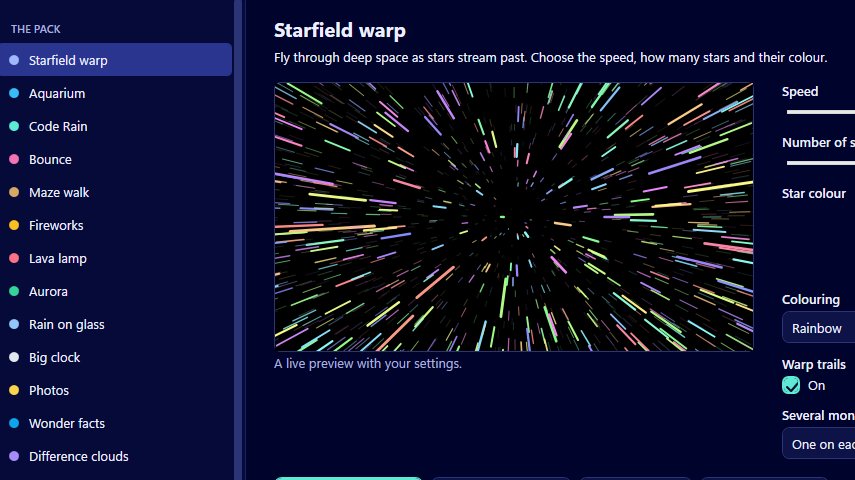
A screensaver has two jobs: to look good while you're away, and to get out of the way the moment you come back. The second is easy to take for granted until it goes wrong, when a screensaver either vanishes because the desk was nudged or refuses to close when you want your work. Screensavers by Zaweba handles this with a few simple rules that every screensaver in the app follows.
They apply to the pack, to the combined screensaver from Install several, and to screensavers you make yourself from a web page folder or a Kinetion by Zaweba animation.
What counts as you coming back
While a screensaver runs, the mouse cursor is hidden, so nothing sits in the middle of the picture. The screensaver closes when the mouse moves more than 10 pixels, or on any key press, mouse click or turn of the wheel.
The 10 pixel rule matters more than it sounds. Optical mice can register tiny movements from a vibration through the desk, a passing lorry or someone putting a mug down. Without a margin, those would end the screensaver for no reason. Ten pixels is enough to ignore the jitter and small enough that any real movement of your hand closes it at once.
The half second grace
Input in the first half second after the screensaver starts is ignored. That covers the moment the screen changes, when a mouse may report a last small movement or a key may still be settling from your last keystroke. Without it, a screensaver could start and close in the same instant and leave you wondering whether it ran at all.
It is short enough that you'll never notice it when you come back to your desk. The screensaver will have been running far longer than half a second by then.
Only one at a time
One copy runs at a time. If Windows asks for the screensaver while it's already running, a second copy doesn't start on top of it. That keeps the processor work down and avoids two pictures fighting for the screen. It's one of the reasons the screensavers stay light, together with the frame cap and the battery saver in Install and options.
Passwords on resume
Windows handles the password on resume, not the app. If you've ticked the option in Windows' Screen Saver Settings to show the sign-in screen when the screensaver ends, Windows takes over as soon as the screensaver closes and asks for your password or PIN as usual. Screensavers by Zaweba doesn't store or see your password at all. The app opens Windows' Screen Saver Settings for you after Use this screensaver, and File then Windows screensaver settings opens it at any time.
The same rules when you preview
Preview full screen in the manager closes in the same way: move the mouse more than 10 pixels or press any key or click. So the preview behaves just as the real thing will, which is useful when you're checking a screensaver you've made yourself.
If you're making your own from a web page folder, you don't need to write any of this. The page runs full screen with no network access and closes on input, handled by the app around it.
When something seems off
If a screensaver closes on its own, check for a mouse on an uneven or shiny surface, where it may register more movement than you'd expect. If it seems slow to close, press a key rather than only nudging the mouse. And if you're never asked for a password when you'd like to be, the setting is in Windows' Screen Saver Settings rather than in the app.

